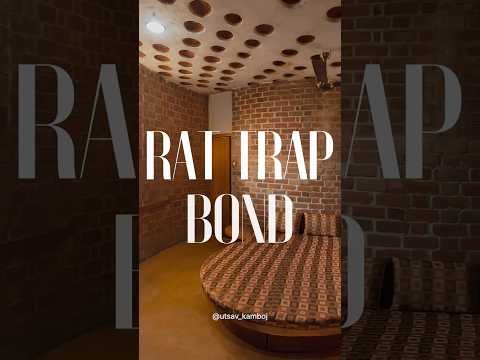
The same brick you use to build a wall can also help keep your home cooler. You just have to lay it differently.
This is Rat Trap Bond, a brick-laying technique where bricks are placed on their edges instead of lying flat. The wall stays almost the same thickness, but a hollow cavity is created inside it.
And that trapped air does the work. Air is a poor conductor of heat, so the cavity slows down heat moving from the outside of the wall to the inside. The result is a wall that can help keep interiors cooler without relying as much on air conditioning.
The cavity can also be useful during construction. Electrical wiring and pipes can run through the hollow space, reducing the need to chase into the finished wall later.
And because you’re creating a cavity instead of filling the entire wall with brick and mortar, the technique can use around 25 to 30% less material. That means less brick, less mortar, lower dead load, and potentially lower construction costs.
No new machine. No expensive material. Just the same brick, arranged differently.
Laurie Baker popularised Rat Trap Bond in Kerala in the 1970s, and the technique became closely associated with his approach to low-cost, climate-responsive construction. Today, architects are still using it. Blurring Boundaries used the technique for Asmalay in Alibag, while Wallmakers used it for Pirouette House in Trivandrum.
The brick never disappeared. We just forgot that sometimes the smartest change isn’t the material. It’s the way you use it.
This is Day 17 of Built Desi, a series on the materials India built itself with, and why we stopped using them. Start from Day 1: Rammed Earth.
I’m Utsav Kamboj, architect and urban designer, documenting How India Builds, the materials, decisions, and stories behind India’s built environment.
Send this to someone who’s building a home. They might want to know about this technique.
#rattrapbond #builtdesi #indianarchitecture #architect #brickarchitecture #sustainablearchitecture #climateresponsive #lauriebaker #india #buildingmaterials